
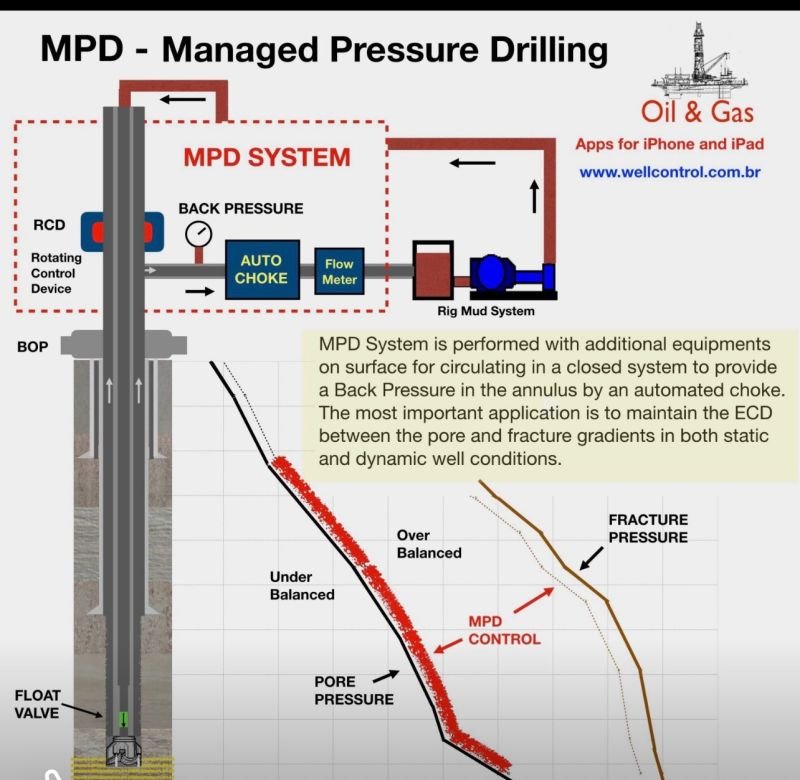
MPD, or Managed Pressure Drilling, is the use of specialized equipment (which can include such items as a Rotating Control Device, additional choke manifold, drill string check valves, and fluid/solids control equipment among others) to control the pressure in a well being drilled. Some are positioned beneath the rig floor in the drill string and fluid return system, whilst other pieces can be located on the deck. As a result, it can help prevent catastrophic #wellcontrol incidents.
Why Is MPD Used?
MPD is used for various reasons. It has the proven ability to make the drilling operation (an inherently dangerous process) safer, more efficient, and cost effective. It allows for closer monitoring of the well and more accurate detection of any anomalies encountered and therefore enhanced response capabilities.
How Is MPD Used?
Managed Pressure Drilling relies heavily on the use of a Rotating Control Device (RCD), which is a major component in providing a closed, pressurized system. This allows for a constant bottom-hole pressure to be applied and also ensures much greater control over fluids flowing in and out of the well. Volume control is a major component of well control alongside keeping the bottom-hole pressure constant (equal to, or slightly greater than formation pressure).
Where Is MPD Used?
MPD is available on all #rig types, from Land Rigs, #jackup Rigs, Tender Rigs, Semi-Submersibles (DP / Moored), and Dynamically Positioned Drill Ships.
When Is MPD Used?
MPD is becoming more commonplace, and in some examples, a necessity, to meet the increasing demands and challenges of the drilling industry, both onshore and #offshore.
It can be extremely useful if the well has very tight margins between letting in an influx (kick) or breaking down the formation, has a high risk of flowing due to the well conditions, or we are likely to experience problems such as differential sticking