
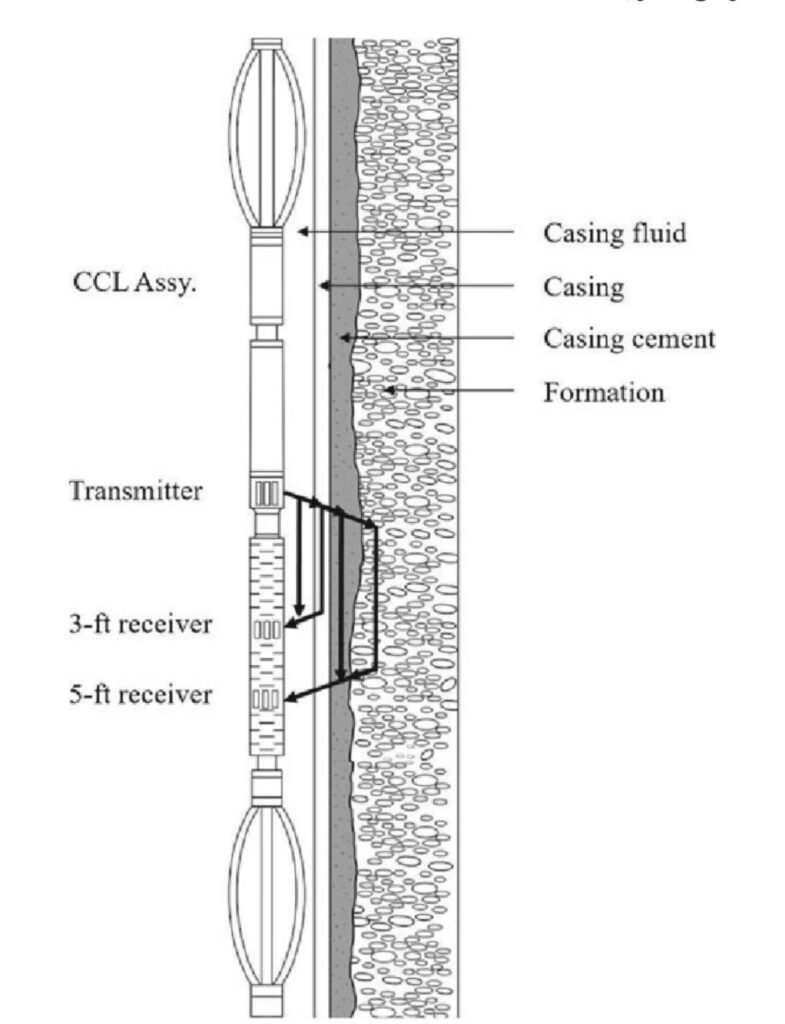
Cement Bond Logging is an acoustic (sonic) logging technique used to assess the integrity and quality of the cement sheath behind the casing. The tool sends sonic waves through the casing and records how those waves travel through the cement and into the formation. The results help determine if the cement is properly bonded to the casing and formation, which is essential for long-term well integrity.
Why is CBL Important?
- Zonal Isolation
Prevents fluid migration between different formation layers (e.g., gas from shallower zones entering deeper oil zones or vice versa). - Well Control and Safety
Ensures that high-pressure zones are sealed and protected, reducing blowout risks. - Casing Protection
A strong cement bond reduces the chance of casing corrosion caused by formation fluids. - Regulatory Compliance
CBL logs are often required to demonstrate that the cement job meets safety and environmental regulations.
How Does CBL Work?
The CBL tool is lowered into the well on a wireline. As it moves up the wellbore, it emits sonic waves (sound pulses) through the casing wall. These waves travel through the cement sheath and into the surrounding formation. Receivers on the tool record how fast and how strongly the waves return.
Good Cement Bond: Sonic energy is absorbed by the solid cement, resulting in weak wave returns (low amplitude).
Poor Cement Bond or Free Pipe: Sonic waves travel more easily through unbonded casing, producing stronger (high amplitude) wave returns.
By analyzing the received signal, especially the amplitude and travel time, engineers can evaluate how well the cement has bonded to both the casing and the formation.
Key Log Outputs from CBL
- Amplitude Log
Shows the strength of the returned sonic signal. Lower values usually mean better cement bonding. - Variable Density Log (VDL)
A waveform display that provides a visual representation of the acoustic signal. It helps detect channels, microannuli, and other cement defects. - Travel Time or Transit Time
Measures how long it takes for the acoustic signal to travel from the transmitter to the receiver. Used to estimate formation contact.
Interpreting CBL Results
Good Bond to Casing and Formation: Low amplitude on CBL and clear waveforms on VDL.
Partial Bond: Medium amplitude with distorted or partial waveforms.
Free Pipe (No Bond): High amplitude and no formation signal on VDL.
Interpretation requires expertise, especially when noise, tool decentralization, or formation heterogeneity affect the signal