
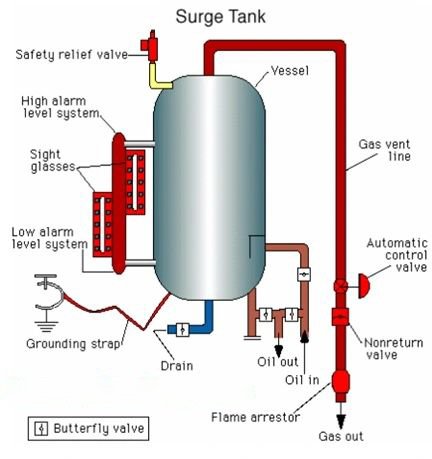
Another important piece of equipment I’ve been observing during surface well testing is the Surge Tank.
After separation in the 3-phase separator, the oil phase flows into the surge tank. Although it looks simple, it plays a very important role in stabilizing flow and ensuring accurate measurement.
What is a Surge Tank?
A surge tank is a temporary storage vessel that:
-Receives oil from the separator
-Reduces flow fluctuations
-Allows additional settling of water
-Provides steady flow to the Storage tank or transfer pump
-It acts as a buffer between the separator and final oil measurement.
How does it works on location?
Oil leaves the separator through the oil outlet.
It enters the surge tank.
Any remaining water droplets settle to the bottom.
Oil accumulates at the top.
Oil is then transferred at a controlled rate to: Storage tank
If the well flow rate suddenly increases or decreases, the surge tank absorbs that fluctuation — preventing unstable flow to the Storage tank.
Why is the Surge Tank Important?
Without a surge tank:
-Oil flow to the Storage tank would fluctuate
-Measurement would be inaccurate
-Oil-water carryover would increase
-Pump cavitation could occur
-Separator level control may become unstable
-The surge tank ensures smooth, controlled oil handling during the test.
What I’m Learning
From observing field operations, I’ve learned that:
-Level control is critical
-Drain valves must be monitored
-Water draw-off must be done carefully
-Overfilling can affect separator back pressure
Every simple equipment plays a major role in overall well test accuracy.
Surface well testing is a chain — every piece of equipment must function correctly for reliable data.