
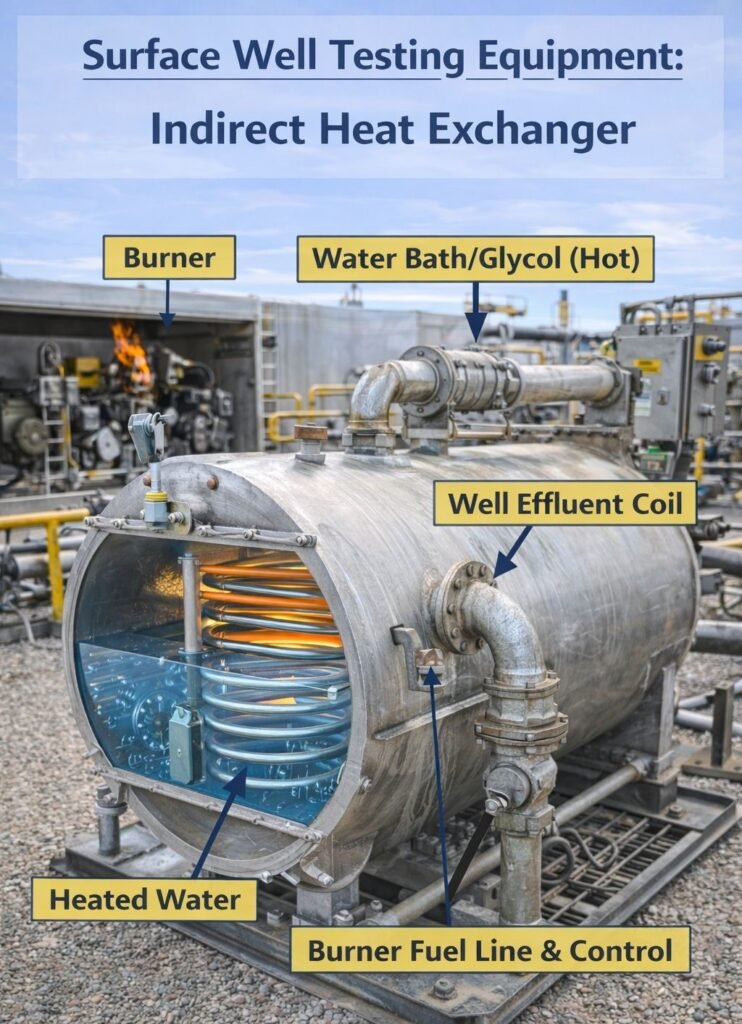
One piece of equipment I’ve come to really appreciate during surface well testing is the indirect heat exchanger.
On location, its job is simple but extremely important:
-Prevent hydrate formation and stabilize the well effluent before separation.
What it is?
The indirect heat exchanger is a heating vessel
Where:
The well effluent flows through a spiral coil, and
The coil is submerged in hot water inside the heater bath
The effluent never comes in direct contact with flame or fuel.
How it operates (what I observed on site)
A burner located at the back of the unit heats the water inside the vessel.
As the water temperature rises, heat is transferred indirectly to the effluent flowing inside the spiral tube.
This process:
-Breaks hydrates in gas-rich streams
-Reduces fluid viscosity
-Prevents icing and line blockage
-Ensures stable flow to the test separator
Heat transfer happens in this order: Burner → Fire tube → Water bath → Coil → Well effluent.
Why it matters in well testing?
Without proper heating:
-Hydrates can block lines
-Pressure readings become unreliable
-Separator performance drops
-Safety risks increase
The indirect heat exchanger ensures the well stream enters the separator in a controlled and predictable condition.
Key takeaway:
Seeing this equipment in operation has shown me that well testing is not just about flowing a well, but about conditioning the flow safely for accurate measurements.