
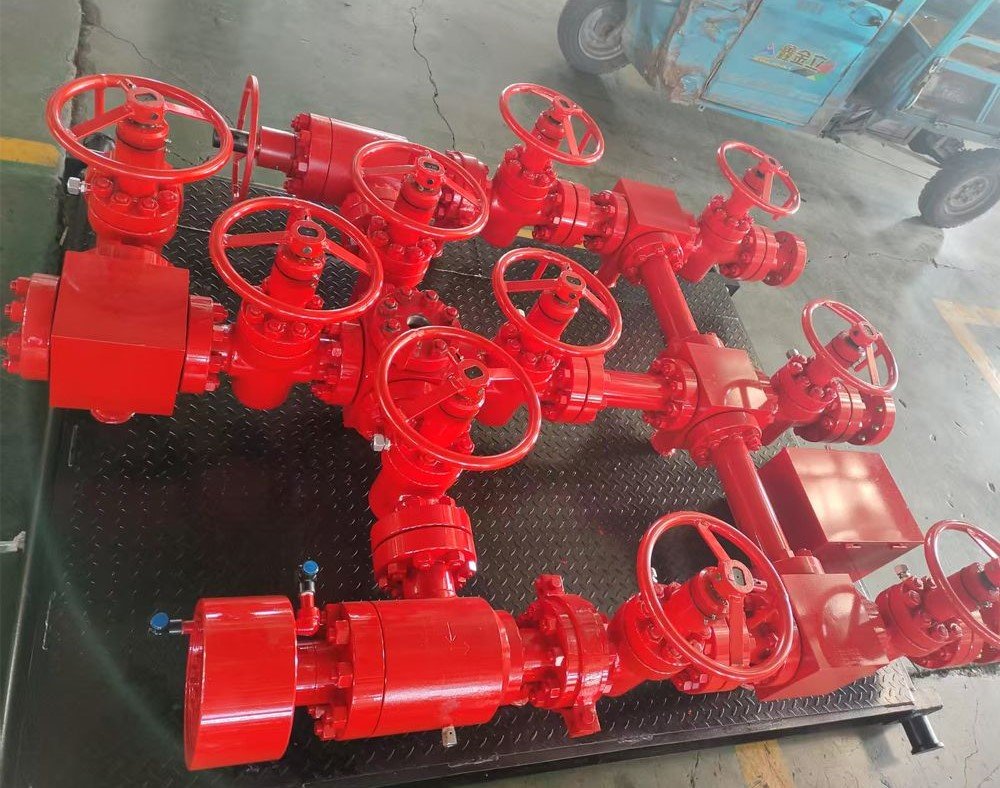
From the wellhead, once the flow passes through the safety systems, it gets to the choke manifold — and this is where real control begins.
The choke manifold is used to:
-Control well flow rate
-Reduce high wellhead pressure gradually
-Protect downstream equipment
-Maintain stable test conditions
-Instead of allowing the well to flow freely, the choke helps us “tame” the well.
Main components
-Fixed chokes – used for steady, long-term flow conditions
-Adjustable chokes – used when we need to fine-tune flow and pressure
-Inlet and outlet headers
-Pressure gauges and bleed lines
-Isolation valves
How it operates (field reality)
As the well flows, the choke restricts the opening, forcing the fluid through a smaller orifice. This restriction causes a pressure drop, which:
-Reduces downstream pressure
-Prevents sudden surges
-Protects the heat exchanger, separator, and other equipment
On site, you can literally see the effect — pressure upstream is high, downstream becomes controlled.
Why does it matter?
Without proper choking:
-Equipment can fail
-Test data becomes unreliable
-Safety risks increase drastically
The choke manifold is not just equipment — it’s a critical safety and control point in well testing.
Being in the field and seeing this in action has helped me understand that well testing is more about control than flow.