
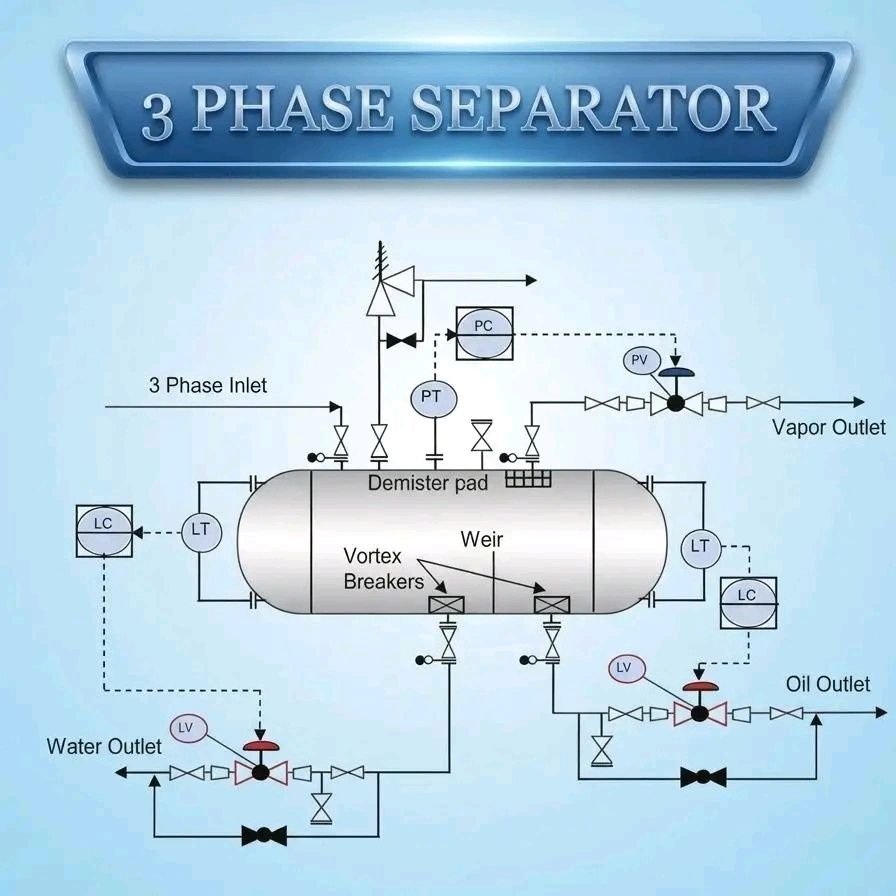
What is a 3-Phase Separator?
A 3-Phase Separator is a pressure vessel used in the oil & gas industry to separate a well stream into three distinct phases:
Gas (Vapor) | Oil (Hydrocarbon Liquid) | Water
It is one of the most important pieces of equipment in upstream oil and gas processing.
Key Components Explained:
- Vessel Body (Horizontal Separator)
The main cylindrical pressure vessel where separation occurs. It provides sufficient residence time for gravity-based separation of gas, oil, and water based on their different densities. - 3-Phase Inlet
Entry point for the incoming well fluid mixture
(gas + oil + water). It usually includes an inlet diverter (not shown but implied) to reduce turbulence and begin initial separation. - Demister Pad
A mesh or vane type pad located in the gas section at the top of the vessel. It captures fine liquid droplets (mist) from the gas stream, preventing them from leaving with the vapor. - Vortex Breakers
Installed at the bottom of the liquid outlets
(oil and water). They prevent the formation of a vortex (whirlpool) that could pull gas or the wrong liquid phase into the outlet, ensuring clean separation. - Weir
A vertical plate inside the vessel that separates the oil compartment from the water compartment. It maintains the oil-water interface at the correct level so that oil overflows the weir while water stays below it. - Level Instruments (LT + LC)
LT (Level Transmitter): Measures the liquid level (oil water interface or total liquid level).
LC (Level Controller): Automatically controls the level by sending signals to the Level Control Valves (LV). - Pressure Instruments (PT + PC + PV)
PT (Pressure Transmitter): Monitors vessel internal pressure.
PC (Pressure Controller): Maintains constant pressure inside the separator.
PV (Pressure Control Valve): Automatically adjusts to release excess gas and keep pressure stable. - Control Valves (LV)
Level Control Valves: Automatically open/close to regulate the outflow of Oil and Water based on signals from the Level Controllers. - Outlets:
Vapor Outlet → Clean gas leaves from the top after passing through the demister pad.
Oil Outlet → Hydrocarbon liquid flows over the weir and exits from the oil compartment.
Water Outlet → Water (heavier phase) exits from the bottom of the water compartment.