
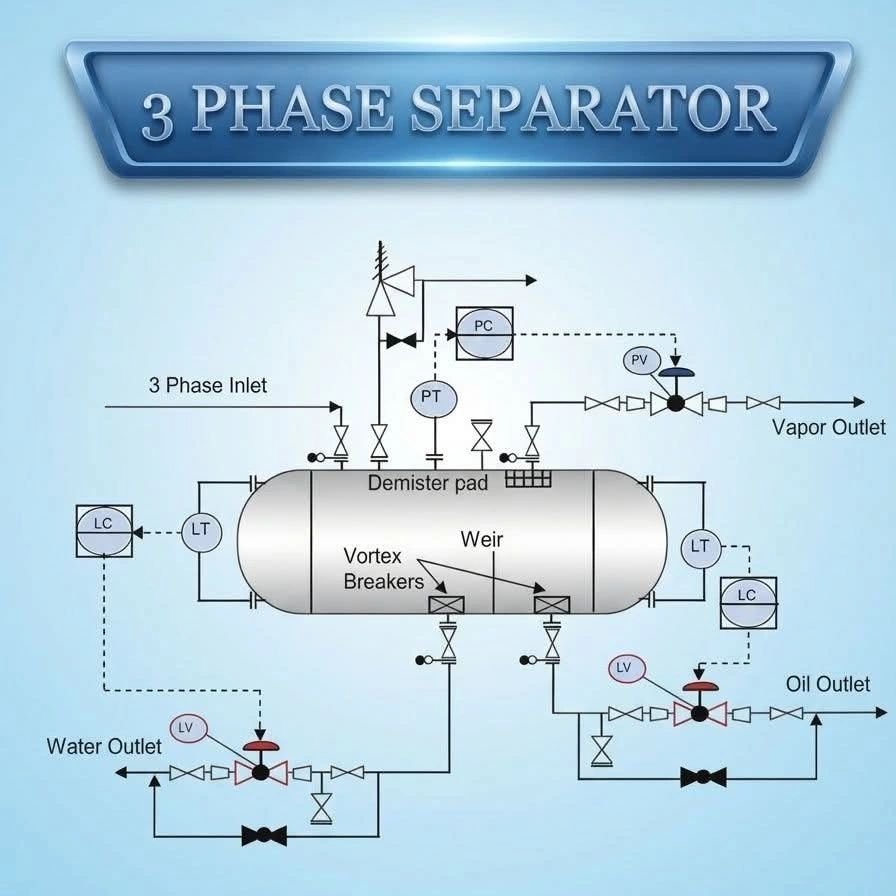
Hazard 1 — Overpressure
Causes: PCV failure closed, blocked outlet, fire case, gas blow-by from liquid side
Safeguards: PSV/PRV sized per API 520; burst disk as secondary protection layer
SIL assessment required where PSV alone is insufficient per IEC 61511
Hazard 2 — Gas Blow-By (Gas Carryunder)
Cause: Low-Low liquid level → gas enters liquid outlet → downstream slugging
Safeguard: LLL ESD shutdown on both water and oil outlets independently
Consequences: Compressor surge, control valve damage, HIPPS activation downstream
Hazard 3 — Liquid Carryover into Gas Line
Causes: Uncontrolled HHL, foaming, demister pad plugging
Safeguards: HHL ESD trip, demister ΔP monitoring with high-ΔP alarm
Consequences: Slug flow in gas line, liquid ingestion into compressor → mechanical failure
Hazard 4 — H₂S / CO₂ Release (Sour Service)
Material selection: NACE MR0175 / ISO 15156 compliance is mandatory
Vessels in H₂S service require PWHT (Post Weld Heat Treatment)
Personnel protection: fixed H₂S gas detectors at vessel area, wind socks, marked escape routes
Hazard 5 — Emulsion Formation
Stable emulsions destroy interface control → water in oil export, oil in produced water
Root causes: excess turbulence at inlet, surfactants, fine solids, high shear across valves
Mitigation: chemical demulsifier injection upstream, electrostatic coalescers for severe cases
Hazard 6 — Sand & Solid Accumulation
Solids settle at vessel bottom → internal erosion, nozzle plugging, level instrument blinding
Mitigation: sand jetting system, upstream sand cyclone, periodic cleaning & pigging
MATERIAL SELECTION CRITERIA
Sweet service → Carbon Steel A516 Gr.70
Sour service (H₂S present) → NACE MR0175 compliant steel + mandatory PWHT
High CO₂ environment → SS316L or Duplex Stainless Steel
High Chloride (Cl⁻) content → Duplex or Super Duplex SS
High temperature + H₂S combined → Alloy 825 or Alloy 625 weld overlay cladding
INSPECTION & INTEGRITY (API 510 / API 581)
Aannual visual check for corrosion, insulation condition, support integrity
Internal inspection: scheduled per RBI plan following API 581
Thickness measurement
Corrosion allowance: typically 1.5 to 3.0 mm incorporated into original design
Nozzle & flange focus: CUI (Corrosion Under Insulation) zones are highest-risk areas
APPLICABLE CODES & STANDARDS
API 12J — Specification for Oil and Gas Separators
API 520 / 521 — Pressure Relief Device Sizing & System Design
API 510 — Pressure Vessel Inspection Code
API 581 — Risk-Based Inspection Methodology
ASME Section VIII Div.1 — Pressure Vessel Design & Fabrication
NACE MR0175 / ISO 15156 — Sour Service Material Requirements
IEC 61511 — Functional Safety / SIL for Process Industry
GPSA Engineering Data Book — Separator Sizing & Internal Design