
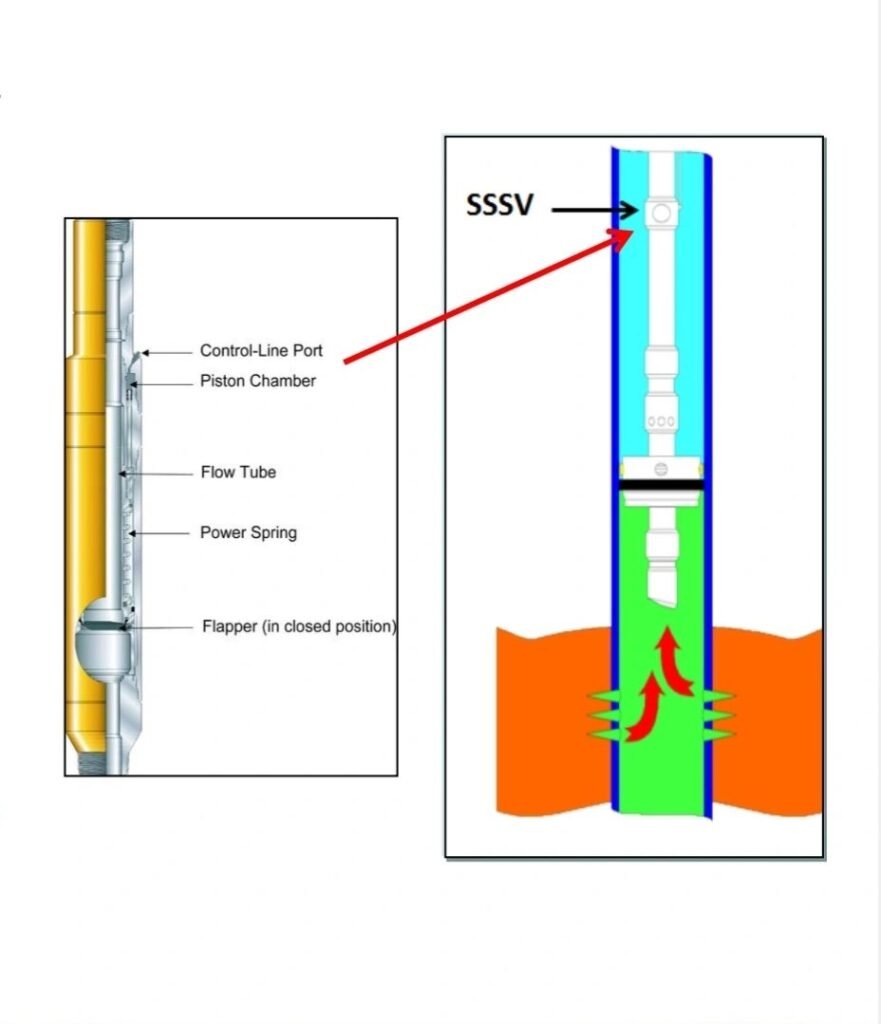
The safety system is installed under the roof as a means of shutting down the well in the event of an uncontrolled accident on the roof.
These systems are classified into two main groups:
1.Controlled subsurface safety valves from inside the well(Subsurface Controlled Subsurface Safety Valves – SSCSSV)
2.Surface-controlled subsurface safety valves(Surface Controlled Subsurface Safety Valves – SCSSV)
-Inside-Well Controlled Subsurface Safety Valves (SSCSSV)
These valves are the older generation of safety valves.
These are mechanically operated valves, often plug valves, although other types such as the flapper valve are available.
These valves are tuned to respond to large changes in flow pressure within the well, causing the valve to automatically shut off.
However, these valves are less reliable than surface-controlled systems, so they are not recommended for use in sensitive applications such as:
1. Offshore wells
2.Or under harsh operating conditions.
-Surface-controlled subsurface safety valves (SCSSV)
These valves are the latest generation of safety valves and are installed in high-importance well completion processes.
In some countries, its use is mandatory as part of safety standards.
Two main types:
1.Wireline Retrievable
Valves that can be retrieved or lowered using a wire without the need to pull the production tube.
2.Tubing Retrievable
Valves that are retrieved with the production tube (tubing), i.e. their output requires the entire pipe shaft to be pulled.