
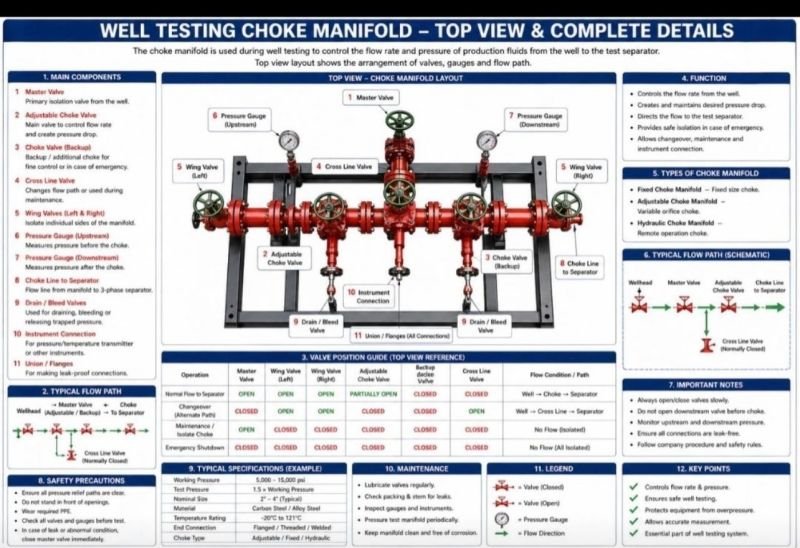
🔷 What is a Well Testing Choke Manifold?
A choke manifold is a high-pressure control system used during well testing to regulate flow rate and pressure coming from the well. It ensures safe handling of hydrocarbons before they go to separators, flare lines, or test equipment.
🔷 Top View (Simple Layout Diagrams
🔷 Main Components
- Inlet Valve
Controls entry of fluid from wellhead
Usually a gate valve (high-pressure rated) - Choke Lines (2 Lines)
Adjustable Choke Line
Manually or hydraulically controlled
Used for precise pressure control
Fixed Choke Line
Has replaceable choke beans (fixed size)
Used for steady flow conditions - Choke Valves
Reduce pressure by restricting flow
Prevent sudden pressure drops (avoids equipment damage) - Outlet Valve
Directs flow to downstream equipment like:
Separator
Flare system - Pressure Gauges
Installed at inlet and outlet
Monitor pressure before and after choke - Kill Line / Bypass Line (Optional)
Used for emergency pressure control or circulation
🔷 Working Principle
Fluid comes from wellhead under high pressure
Enters choke manifold via inlet valve
Flow is split into choke lines
Choke reduces pressure by restricting flow area
Controlled flow exits to separator or flare
👉 Main aim:
Maintain controlled pressure + safe flow rate
🔷 Types of Chokes Used
Fixed Choke (Bean type)
Adjustable Choke (Needle type / Hydraulic choke)
🔷 Pressure Rating
Common ratings:
5K psi
10K psi
15K psi
(Depends on well pressure)
🔷 Safety Features
High-pressure rated valves
Erosion-resistant materials
Pressure relief system
Redundant choke lines (backup system)
🔷 Uses in Oilfield
Well testing operations
Flowback operations
Well cleanup
Pressure control before separator
🔷 Key Interview Points (Oilfield)
Purpose: Pressure & flow control
Two lines: Adjustable + Fixed
Installed between: Wellhead → Separator
Main risk: Erosion & high pressure
Safety: Never fully open without control.