
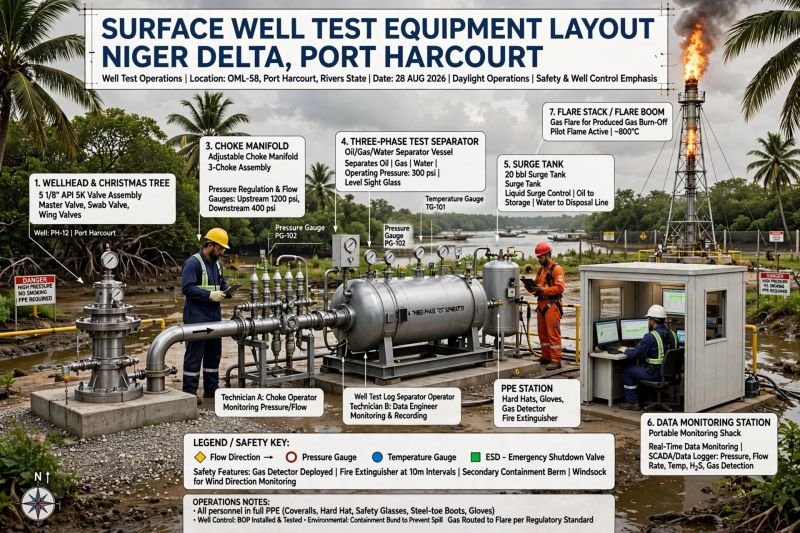
Field: Ango Field, OML 59, Koluama, Southern Ijaw LGA, Bayelsa State — operated by Conoil – Niger Delta Swamp Area
1. Introduction
During my field exposure to Ango Field, OML 59, Koluama, Southern Ijaw LGA, Bayelsa State — operated by Conoil.-oil and gas operations in the Niger Delta, I participated in and observed well testing operations conducted by Oiltest Services Limited in Port Harcourt. The exercise was aimed at evaluating well deliverability and understanding reservoir characteristics.
2.Objective of the Test
The primary objective was to determine well productivity, reservoir pressure behavior, fluid properties, and overall reservoir performance to support completion decisions and future production planning.
3.Scope of Activities Observed
The well testing operation was carried out in a systematic and safety-critical sequence:
a) Well Preparation for Testing: This involved wellbore conditioning, installation of downhole test tools, and ensuring well integrity and control prior to flow initiation. The wellhead and associated valves were inspected and pressure-tested.
b) Surface Test Equipment Rig-up and Checks: Surface well testing equipment including the test manifold, choke manifold, three-phase separator, surge tank, flow lines, gauges, and flare system were installed. All equipment was function-tested, calibrated, and checked for leaks and pressure integrity in line with operational procedures.
c) Well Flow and Monitoring: The well was flowed at controlled rates using variable choke sizes. During flow periods, key parameters were continuously monitored and recorded, including wellhead pressure, flowing temperature, separator pressure, oil rate, gas rate, and water cut.
d) Sampling: Representative samples of oil, gas, and produced water were collected at the separator for laboratory analysis to determine fluid composition, Basic Sediment and Water (BS&W), Gas-Oil Ratio (GOR), API gravity, and other PVT properties.
e) Data Acquisition and Evaluation: The recorded pressure, temperature, and flow rate data were compiled for analysis. The test results were used to assess well productivity index, formation damage, reservoir permeability, and overall reservoir performance.
4.HSE and Well Control
Throughout the operation, strict adherence to well control, safety, environmental protection, and standard operating procedures was maintained. This included use of PPE, toolbox talks, emergency response readiness, safe handling of hydrocarbons, and compliance with environmental regulations to prevent pollution.
Overall Learning Outcome
The exposure provided practical insight into surface well testing operations, from equipment rig-up to data interpretation, and reinforced the importance of accurate measurement, operational discipline, and safety in optimizing hydrocarbon production in the Niger Delta.