
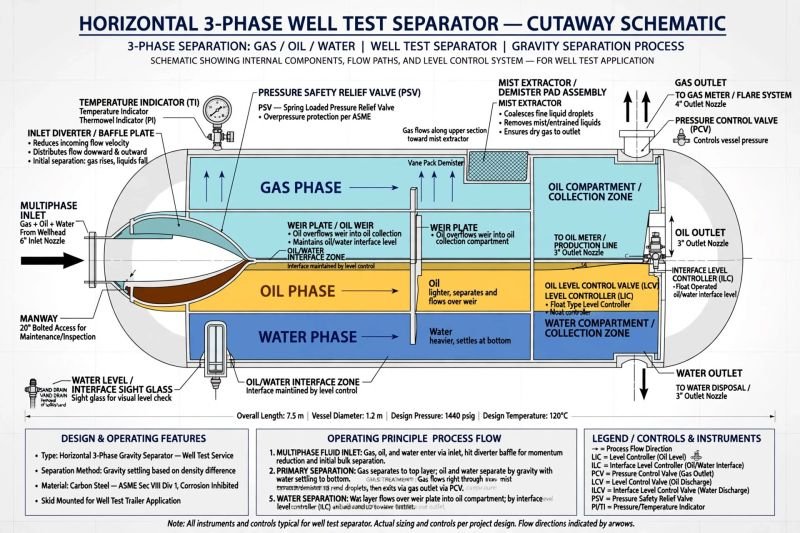
A well test separator separates the wellstream into gas, oil, and water so that each phase can be measured accurately and the well’s performance evaluated.
The main objective is to maintain stable separator pressure and level while obtaining accurate oil, gas, and water measurements without exceeding equipment operating limits.
Important: Actual separator pressure, temperature, level, relief settings, and operating limits must always come from the approved operating procedure/P&ID and equipment design data—not generic calculations.
- Oil, water and total liquid rate
If oil and water rates are measured:
by
total liquid rate
oil rate
water rate
Example:
Oil = 1,000 BOPD, Water = 250 BWPD - Water cut
Using the example:
So the well has 20% water cut. - Gas-Oil Ratio (GOR)
If gas rate is 2,000 Mscf/d and oil rate is 1,000 BOPD:
or 2,000 scf/bbl. - Gas-Water Ratio (GWR)
For 2,000 Mscf/d gas and 250 BWPD: - Shrinkage / conversion
If measured liquid volume is converted to a standard reference condition, apply the appropriate volume correction factor (VCF):
The actual factor depends on the fluid properties, pressure, temperature, and applicable standard. - Separator residence time
Residence time indicates how long the fluid remains in the separator:
For example, if effective liquid volume is 50 bbl and liquid flow is 1,000 BPD:
A suitable residence time helps achieve proper phase separation.
Key operator checks
An experienced operator should continuously monitor:
Pressure → Temperature → Liquid level → Flow rates → Control valves → Alarms/ESD → Meter readings