
The Backbone of Mechanical Oil Production
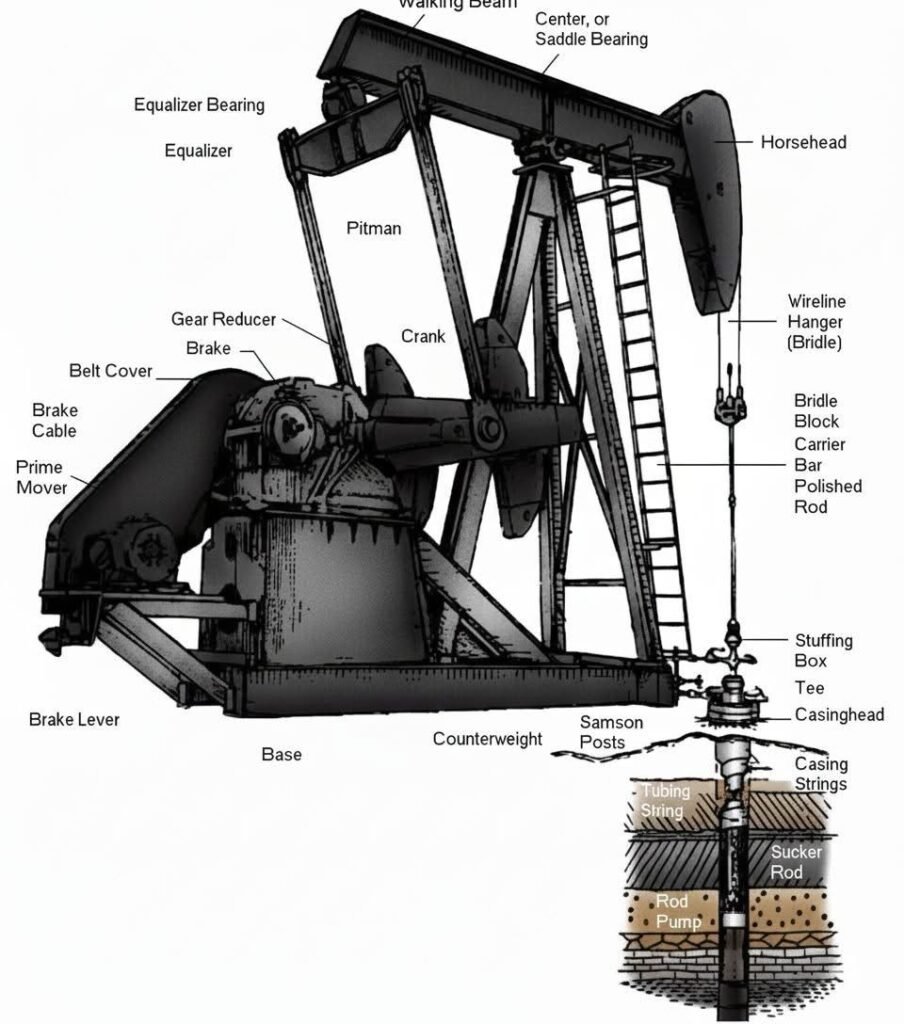
This image clearly illustrates the components and working principle of a Pumpjack, one of the most widely used artificial lift systems for oil wells when natural reservoir pressure is no longer sufficient to bring fluids to the surface.
Let’s break it down
Key Pumpjack Components & Their Functions
Walking Beam
The main horizontal beam that pivots on the saddle bearing, transmitting motion to the sucker rod system.
Horsehead
A curved steel head that ensures smooth, vertical movement of the polished rod and proper load distribution.
Equalizer & Equalizer Bearing
They balance the walking beam and reduce cyclic stress on the system.
Pitman
Connects the crank to the walking beam, converting rotary motion into vertical movement.
Crank
Transforms rotational energy from the prime mover into oscillating motion.
Gear Reducer
Reduces motor speed to the optimal pumping speed while increasing torque.
Counterweights
Balance the rod string load, minimizing power consumption and mechanical wear.
Prime Mover
The power source (electric motor or engine) driving the entire system.
Base
Provides structural stability and supports all pumpjack components.
Stuffing Box
Creates a pressure-tight seal around the polished rod to prevent surface leaks.
Polished Rod
Transfers motion from surface equipment to the downhole sucker rod string.
Sucker Rod
A steel rod string that delivers motion downhole to the pump.
Rod Pump (Downhole Pump)
The heart of the system, lifting oil from the reservoir to the surface.
Tubing & Casing
Tubing: Flow path for produced fluids
Casing: Supports the wellbore and isolates formations
Bridle Block & Wireline Hanger
Ensure stable and aligned movement between the horsehead and polished rod.
Samson Posts
Vertical supports holding the walking beam assembly.
Gas Lift – A Powerful Alternative Artificial Lift Method
While Pumpjacks rely on mechanical lifting, Gas Lift enhances production using injected gas.
How Gas Lift Works:
Compressed gas is injected into the well
Fluid density is reduced
Hydrostatic pressure decreases
Reservoir energy pushes fluids to surface more efficiently
Key Advantages:
Ideal for deviated & horizontal wells
Excellent for sand-producing wells
Less mechanical wear compared to rod pumping
Can be combined with pumpjack in deep or high-fluid wells
Conclusion
Pumpjacks remain a cornerstone of artificial lift, especially in mature oil fields.
However, Gas Lift offers a flexible and efficient alternative where mechanical pumping becomes limited