
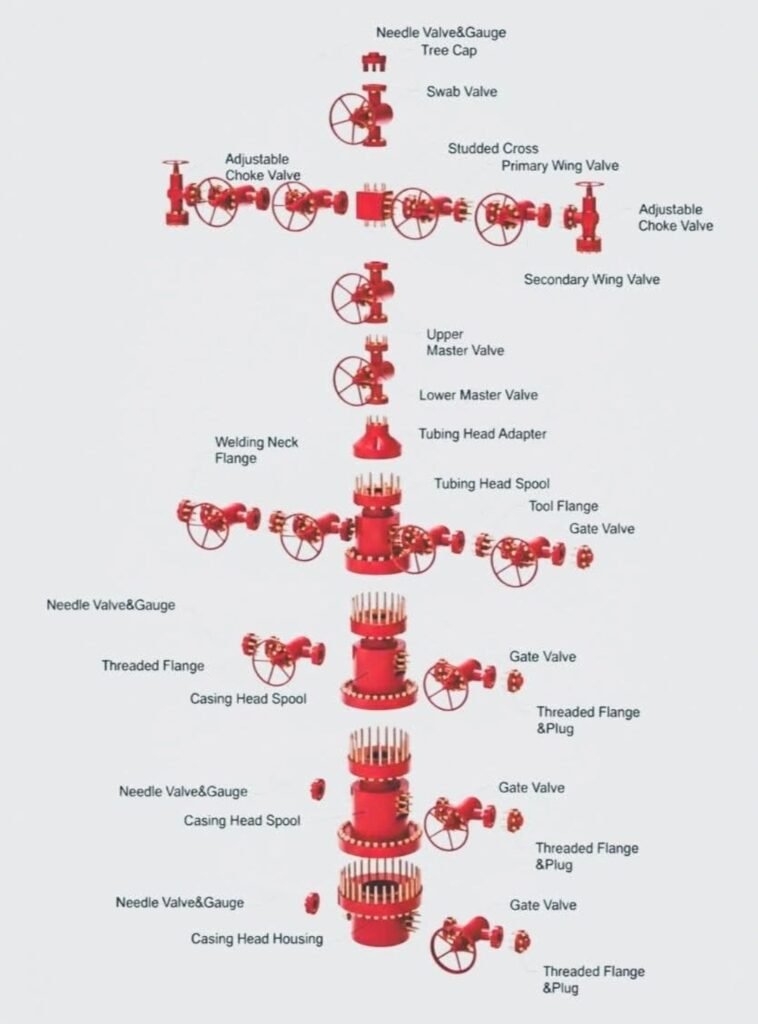
The wellhead, also known as the Christmas tree, is part of the wellhead assembly. In well testing, these components are the first line of defense and the primary control for fluid flow from the well to the surface.
The most important parts, as shown in the image, and their roles during well testing are:
- Master Valves
Lower & Upper Master Valves: These are the two most important valves in the wellhead assembly. Their function is to completely shut down the well in case of an emergency. The lower valve usually remains open, while day-to-day control is handled by the upper valve. - Wing Valves
Primary & Secondary Wing Valves: These direct the oil or gas to the flowline leading to the testing equipment (such as the manifold and separator).
During well testing, we use the wing valves to open and close the flow to start or end the test.
- Swab Valve
This is the valve located at the very top. Its function is to allow the wireline or coiled tubing tools to be inserted into the wellbore to measure the pressure and temperature (BHP/BHT) at the bottom of the well during testing. - Adjustable Choke Valve
Located at the wingtips, this is the “tap” through which we control the flow rate.
During the well test, we change the choke opening (e.g., 16/64, 32/64 inches) to observe the well’s response at different pressures and production rates.
- Wellhead Components
Casing Head & Spools: These are the supports that hold the casing. During the well test, we monitor the pressure in these spaces (annulus pressure) to ensure there is no communication leakage between the tubing.
Tubing Head Spool: This is the part that supports the production tubing from which the fluid exits. Why is this image important for the well test engineer?
Safety: They must ensure that all these valves are functioning and have undergone pressure testing before opening the well.
Sampling: We install sampling points at the wing valves to determine the quality of the oil and gas before they reach the station.
Data Acquisition: We install pressure and temperature sensors (transducers) on the tree cap or wing to record well data in real time.