
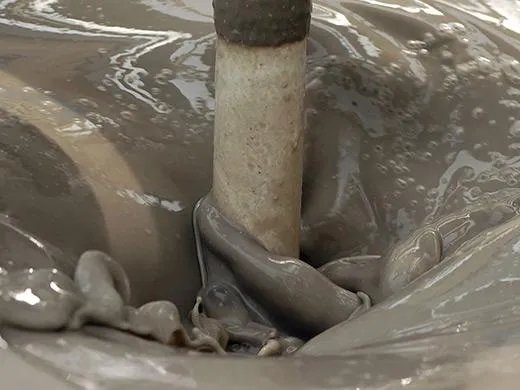
When drilling a well, engineers don’t rely on just one type of drilling fluid.
Different formations and drilling conditions require different mud systems.
Two of the most widely used drilling fluid systems are:
Water-Based Mud (WBM) and Oil-Based Mud (OBM).
The main difference lies in the continuous phase of the drilling fluid.
In Water-Based Mud, water acts as the continuous phase, while various additives are used to control properties such as viscosity, filtration, and density.
Some common additives in WBM include:
- Bentonite – improves viscosity and helps with hole cleaning
- Barite – used as a weighting agent to increase mud density
- PAC/CMC – helps reduce fluid loss and improve filtration control
- KCl – used to inhibit shale swelling
In Oil-Based Mud, oil forms the continuous phase while water is dispersed within it, creating an invert emulsion system.
OBM systems often include additives such as:
- Barite or CaCO₃ – used as weighting agents to control mud density
- Primary emulsifier – helps maintain a stable oil-water emulsion
- Secondary emulsifier – strengthens emulsion stability
- Lime – helps maintain alkalinity and support emulsifier performance
Oil-based muds are often selected for challenging drilling environments because they provide:
- Better shale inhibition
- Improved lubrication
- Higher thermal stability
Ultimately, the choice between WBM and OBM depends on formation conditions, environmental considerations, and drilling objectives.
Professional insight:
Mud engineers in the field—what formation conditions typically make OBM the preferred option over WBM during drilling operations?
Food for Thought:
Why do you think oil-based mud systems perform better when drilling through reactive shale formations?
30 Days of Mud Engineering-Day 1-What Is Drilling
30 Days of Mud Engineering-Day 2-What Is Drilling Fluid
30 Days of Mud Engineering-Day 3-How Does Drilling Fluid Control Formation Pressure
30 Days of Mud Engineering-Day 4-How Do Engineers Determine The Right Mud Weight for a Formation
30 Days of Mud Engineering-Day 6-Mud Weight
30 Days of Mud Engineering-Day 7-Why Must Drilling Mud Flow Properly
30 Days of Mud Engineering-Day 8-What Determines How Drilling Mud Actually Flows Inside The Wellbore
30 Days of Mud Engineering-Day 9-Plastic Viscosity (PV) and Yield Point (YP)
30 Days of Mud Engineering-Day 10-Fluid Loss or Filtration
30 Days of Mud Engineering-Day 11-Retort Test
30 Days of Mud Engineering-Day 12-How Stable Is The Emulsion
30 Days of Mud Engineering-Day 13-Water-Based Mud (WBM) and Oil-Based Mud (OBM)
30 Days of Mud Engineering-Day 14-Shale
30 Days of Mud Engineering-Day 15-Shale Inhibition
30 Days of Mud Engineering-Day 16-KCl–Polymer Mud
30 Days of Mud Engineering-Day 17-What Happens to All the Solids Generated During Drilling
30 Days of Mud Engineering-Day 18-How Do Mud Engineers Remove Unwanted Solids From Drilling Fluid
30 Days of Mud Engineering-Day 19-How Do Mud Engineers Maintain The Right Mud Weight During Drilling
30 Days of Mud Engineering-Day 20-Hole Cleaning
30 Days of Mud Engineering-Day 21-Stuck Pipe (Very High Engagement Topic)
30 Days of Mud Engineering-Day 22-Lost Circulation
30 Days of Mud Engineering-Day 23-Lost Circulation Materials (LCM)
30 Days of Mud Engineering-Day 24-Barite Sag
30 Days of Mud Engineering-Day 25-Gas Contamination
30 Days of Mud Engineering-Day 26-Downhole Temperature Impact On the Drilling Fluids
30 Days of Mud Engineering-Day 27-What Is The Role Of A Mud Engineer
30 Days of Mud Engineering-Day 28-How Dynamic The Role of Mud Engineer
30 Days of Mud Engineering-Day 29-What Skills Are Essential For A Mud Engineer