
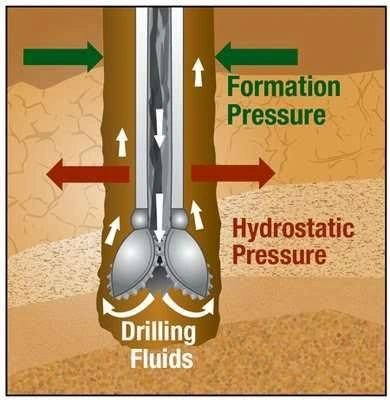
Let’s look at what happens when formation pressure is greater than mud pressure, shall we?
When drilling penetrates a formation, that formation may contain fluids under pressure.
If the pressure from the mud column (hydrostatic pressure) is lower than the formation pressure, formation fluids can enter the wellbore.
This is called a kick.
Let me give a little guide before we continue, and that will be ‘What is hydrostatic pressure?’
Hydrostatic pressure is the pressure exerted by a column of fluid due to its weight.
Now, imagine diving into a swimming pool. The deeper you go, the more pressure you feel in your ears.
Why?
Because the water above you has weight.
That weight creates pressure.
That is hydrostatic pressure.
How Mud Prevents It?
Drilling fluid controls formation pressure through its density (mud weight).
Hydrostatic pressure depends on:
• Mud weight
• True vertical depth (TVD)
The deeper the well and the heavier the mud, the greater the hydrostatic pressure exerted.
By carefully adjusting mud weight, we maintain pressure balance and prevent influx (KICK).
Practical Reinforcement
If mud weight is too low → Kick risk
If mud weight is too high → Formation fracture risk
Food for thought:
Have you ever wondered how engineers determine the right mud weight for a specific formation?
30 Days of Mud Engineering-Day 1-What Is Drilling
30 Days of Mud Engineering-Day 2-What Is Drilling Fluid
30 Days of Mud Engineering-Day 3-How Does Drilling Fluid Control Formation Pressure
30 Days of Mud Engineering-Day 4-How Do Engineers Determine The Right Mud Weight for a Formation
30 Days of Mud Engineering-Day 6-Mud Weight
30 Days of Mud Engineering-Day 7-Why Must Drilling Mud Flow Properly
30 Days of Mud Engineering-Day 8-What Determines How Drilling Mud Actually Flows Inside The Wellbore
30 Days of Mud Engineering-Day 9-Plastic Viscosity (PV) and Yield Point (YP)
30 Days of Mud Engineering-Day 10-Fluid Loss or Filtration
30 Days of Mud Engineering-Day 11-Retort Test
30 Days of Mud Engineering-Day 12-How Stable Is The Emulsion
30 Days of Mud Engineering-Day 13-Water-Based Mud (WBM) and Oil-Based Mud (OBM)
30 Days of Mud Engineering-Day 14-Shale
30 Days of Mud Engineering-Day 15-Shale Inhibition
30 Days of Mud Engineering-Day 16-KCl–Polymer Mud
30 Days of Mud Engineering-Day 17-What Happens to All the Solids Generated During Drilling
30 Days of Mud Engineering-Day 18-How Do Mud Engineers Remove Unwanted Solids From Drilling Fluid
30 Days of Mud Engineering-Day 19-How Do Mud Engineers Maintain The Right Mud Weight During Drilling
30 Days of Mud Engineering-Day 20-Hole Cleaning
30 Days of Mud Engineering-Day 21-Stuck Pipe (Very High Engagement Topic)
30 Days of Mud Engineering-Day 22-Lost Circulation
30 Days of Mud Engineering-Day 23-Lost Circulation Materials (LCM)
30 Days of Mud Engineering-Day 24-Barite Sag
30 Days of Mud Engineering-Day 25-Gas Contamination
30 Days of Mud Engineering-Day 26-Downhole Temperature Impact On the Drilling Fluids
30 Days of Mud Engineering-Day 27-What Is The Role Of A Mud Engineer
30 Days of Mud Engineering-Day 28-How Dynamic The Role of Mud Engineer
30 Days of Mud Engineering-Day 29-What Skills Are Essential For A Mud Engineer