
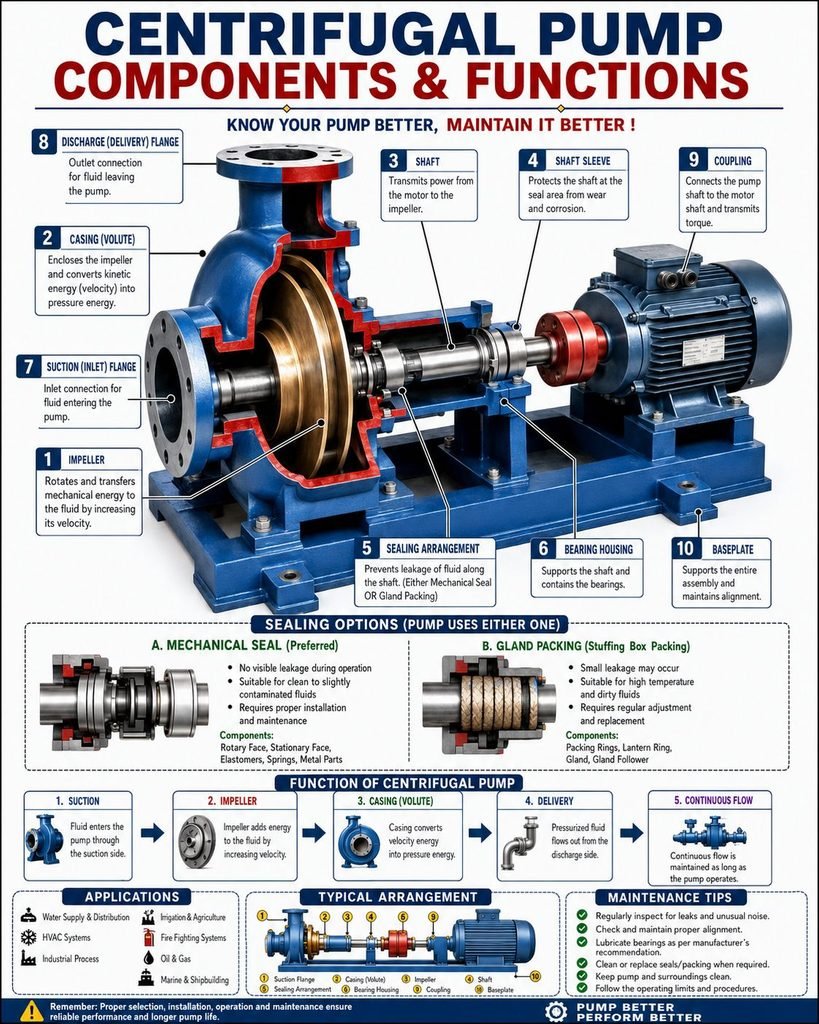
From water treatment plants to refineries, power stations, and manufacturing facilities, centrifugal pumps play a critical role in moving fluids efficiently and reliably.
Understanding the main components helps engineers and technicians troubleshoot problems, improve reliability, and extend equipment life.
🔹 Impeller
The rotating component that transfers energy to the fluid and creates flow.
🔹 Casing (Volute)
Converts fluid velocity into pressure and directs flow through the pump.
🔹 Shaft
Transmits power from the motor to the impeller.
🔹 Shaft Sleeve
Protects the shaft from wear, corrosion, and seal damage.
🔹 Mechanical Seal / Packing
Prevents fluid leakage along the rotating shaft.
🔹 Bearings
Support the shaft and ensure smooth rotation.
🔹 Coupling
Transfers torque from the motor to the pump.
🔹 Suction & Discharge Flanges
Provide the inlet and outlet connections for fluid flow.
💡 How a centrifugal pump works:
1️⃣ Fluid enters through the suction side
2️⃣ The impeller accelerates the fluid outward
3️⃣ The casing converts velocity into pressure
4️⃣ Pressurized fluid exits through the discharge side
🛠️ Common maintenance practices:
✔ Monitor vibration and noise levels
✔ Check bearing condition regularly
✔ Inspect seals for leakage
✔ Verify alignment between pump and motor
✔ Monitor temperature and lubrication
✔ Prevent cavitation through proper system design
Remember:
Most pump failures are not caused by the pump itself—but by poor operation, misalignment, inadequate maintenance, or process issues.
A well-maintained pump means:
✅ Higher reliability
✅ Lower downtime
✅ Reduced maintenance costs
✅ Improved plant efficiency
Because in industrial operations, reliability is not an accident—it is engineered.