
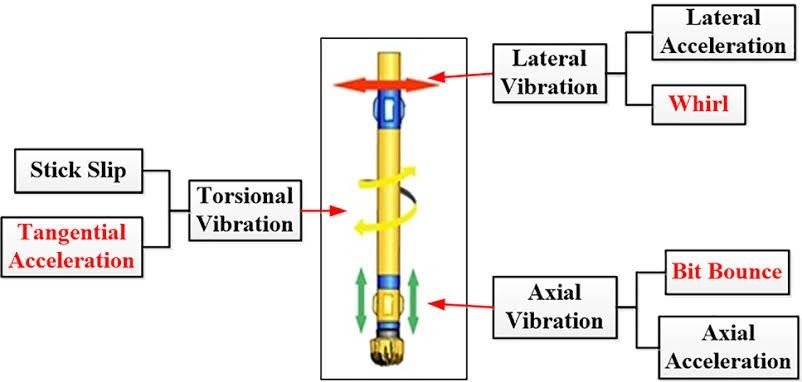
Since drilling is the process of cutting rock by chipping or crushing, vibrations are almost unavoidable during drilling operations. Downhole vibration is typically measured and monitored using sensors placed within the drilling assembly and is commonly reported as root-mean-square acceleration to help field technicians analyze subsurface conditions and drilling performance.
Downhole #vibration generally occurs in three principal modes:
- Lateral Vibration
Lateral vibration is transverse to the drilling tool axis and usually occurs when the drill string moves laterally relative to its rotation axis. It is closely related to the bending of the drilling axis and resonance at critical rotary speeds.
This vibration mode includes:
- Lateral acceleration
- Whirl (forward and backward whirling) caused by off-center rotation and wellbore contact.
Lateral vibration is typically associated with high-frequency dynamics and is considered one of the most destructive vibration modes, responsible for a large percentage of drill string and BHA failures, stabilizer wear, and damage to drilling electronics.
- Axial Vibration
Axial vibration occurs parallel to the drilling tool axis when the drill string moves along its rotation axis. It is commonly associated with bit bounce, which results from the interaction between the drill bit and formation.
Axial vibration often appears in the 3–20 Hz frequency range and can lead to cutter wear, bearing failure, and unstable drilling performance.
- Torsional Vibration (Stick-Slip)
Torsional vibration, also referred to as stick-slip vibration, is characterized by alternating phases of rotational acceleration and deceleration.
During the stick phase, the drill bit temporarily stops rotating while torque builds up in the drill string. Once the stored torsional energy is released, the system enters the slip phase, where the drill string rapidly accelerates.
This phenomenon causes irregular downhole rotation, material fatigue, tool damage, and reduced drilling efficiency.
In modern drilling operations, monitoring, modeling, and simulation of vibration behavior are essential for understanding drilling tool dynamics, improving drilling performance, and preventing premature tool failures—especially in high-temperature and high-pressure downhole environments.