
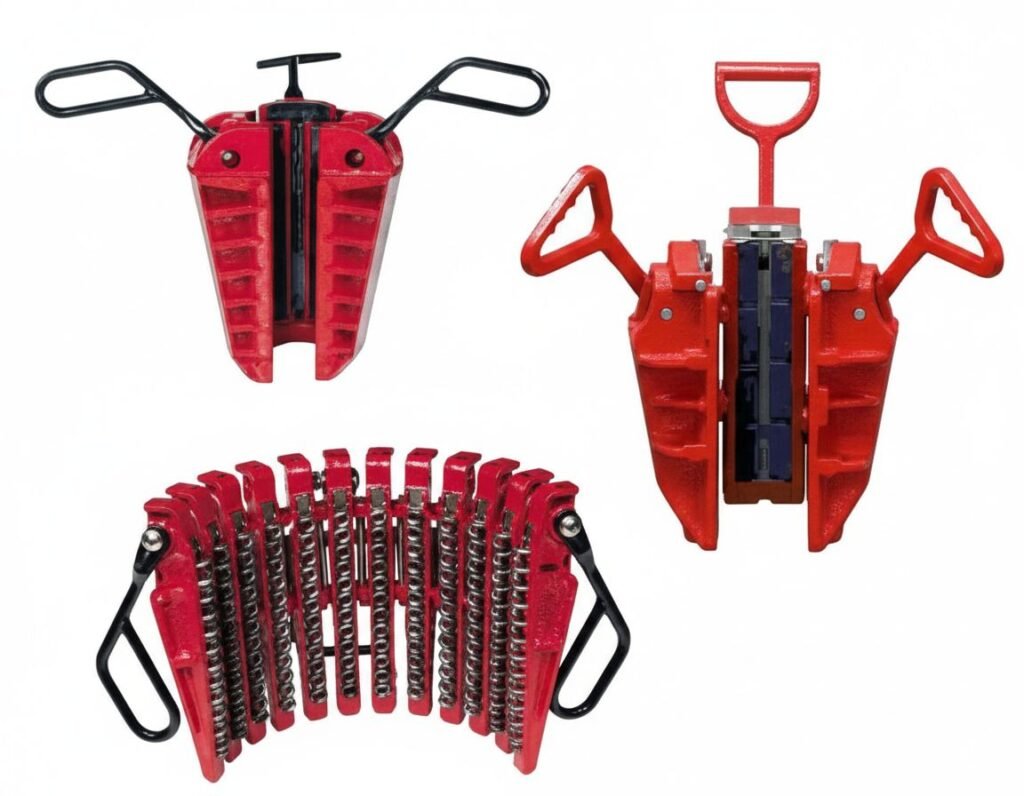
In the oil and gas industry, slips are essential mechanical devices used to grip and suspend the drill string in the rotary table on the drill floor. They prevent the heavy pipe from falling down into the wellbore when it is disconnected from the hoist.
Think of them as a “wedge-lock” system: the more weight the pipe puts on them, the tighter they grip.
Types of slips:
⏩ DRILL PIPE SLIP
They usually have a larger “wrap-around” range to accommodate the tool joints.
SIZE: 2 3/8″, 2 7/8,3 1/2″, 4″, 4 1/2″, 5″, 5 1/2″, 6 5/8″, 7″
⏩ DRILL COLLARS SLIP
Drill collars are thick-walled, very heavy, and completely smooth (they lack the “shoulder” or tool joint found on drill pipe).
Design: They are multi-segmented (usually 7 to 12 segments). This allows the slip to wrap perfectly around the circumference of the collar.
The Grip: They use circular buttons (inserts) rather than long flat dies. These buttons “bite” into the smooth surface of the collar.
Safety Requirement: Because there is no shoulder on a drill collar, you must use a Safety Clamp above the slips. If the slips lose friction, the clamp prevents the collar from sliding into the well.
⏩ CASING SLIP
Casing is the large-diameter pipe used to line the wellbore. Compared to drill collars, casing has a thin wall.
Design: Casing slips have a much larger surface area and many more segments (up to 20+ segments for large casing).
The Grip: The goal is to distribute the massive weight of the casing string over a wide area. If you used a small drill pipe slip on casing, the concentrated pressure would crush or “bottleneck” the casing
size and model. no.of segments
3″-4″ 7
4″-47/8″ 7
DCS-R (Regular)
4 1/2″-6″ 9
5 1/2″-7″ 9
DCS-L (Large)
6 3/4″-8 1/4″ 11
8″ -9 1/2″ 11
9 1/4″-11 1/4″ 12
11″-12 3/4″ 12
Type C-1
12 1/4″-14″ 17