
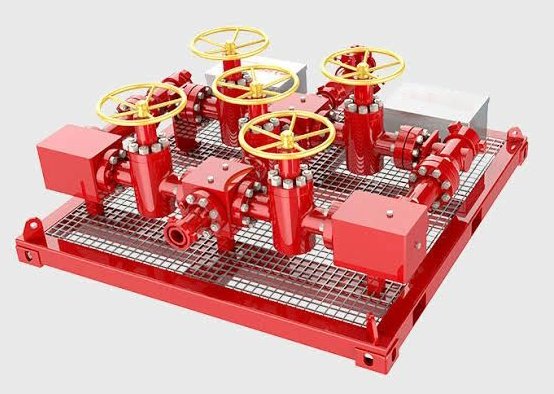
In surface well testing, controlling the flow of hydrocarbons safely and accurately is critical—and this is where the choke manifold plays a major role.
A choke manifold is a high-pressure arrangement of valves, flowlines, and chokes used to control the flow rate and pressure of well fluids during operations.
Its key functions include:
🔹 Controlling flow rate from the well.
🔹 Reducing high wellhead pressure to a manageable downstream pressure.
🔹 Regulating drawdown during well testing.
🔹 Providing flexibility through multiple flow paths and choke options.
🔹 Allowing safe isolation and maintenance of equipment.
🔹 Protecting downstream equipment from excessive pressure and flow conditions.
The choke is especially important because even a small adjustment in choke size can significantly affect flow rate, wellhead pressure, separator conditions, and overall well performance.
During well testing, choke management helps engineers and operators obtain reliable data while maintaining safe operating conditions.
A proper understanding of the choke manifold is therefore essential for anyone involved in surface well testing, flowback operations, and well performance evaluation.
In well testing, the choke is not just a restriction—it is a critical tool for controlling the well and understanding its behaviour.