
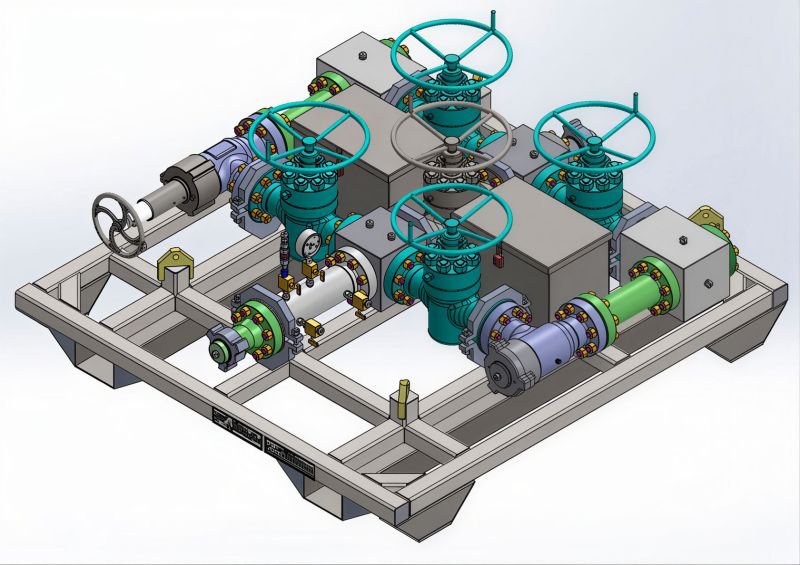
A Critical Component in Well Testing Operations
In well testing, pressure control and flow regulation are everything. One of the most critical pieces of surface equipment that makes this possible is the choke manifold.
The choke manifold is designed to control flow rate, manage pressure, and ensure safe diversion of produced fluids during well testing operations.
Key Components and Their Importance
- The Four Valves: The choke manifold is typically equipped with four main valves, each serving a vital role:
Two inlet valves – allow the well flow to enter the manifold.
Two outlet valves – direct flow either to the test separator, flare line, or other surface facilities.
These valves:
- Provide redundancy in case one valve fails
- Allow safe isolation during maintenance or emergencies
- Enable smooth switching between chokes without shutting in the well
- The Two Chokes The choke manifold operates with:
- Fixed Choke
- Adjustable (Variable) Choke
Each has a specific purpose in well testing.
Fixed Choke
- Has a fixed bean size
- Provides a constant flow restriction
- Commonly used when stable flow conditions are required
- Reliable, simple, and less prone to erosion adjustments
Adjustable Choke (Detailed Operation)
The adjustable choke is the most flexible and frequently used during dynamic well testing.
How it is used:
- The choke opening is gradually adjusted using a hand wheel or hydraulic actuator
- Flow rate is increased or reduced by carefully opening or closing the choke
- Pressure downstream is constantly monitored
- Adjustments are made slowly to:
– Prevent pressure surges
– Avoid sand production issues
– Minimize erosion and vibration
This choke allows operators to:
- Control drawdown
- Match surface facility limits
- Respond quickly to changing well conditions
Safe Operation & Maintenance
Safety and maintenance of the choke manifold are non-negotiable:
- Regular inspection for erosion, leaks, and corrosion
- Proper lubrication of moving parts
- Pressure testing before operations
- Ensuring valves are clearly labeled and functional
- Only trained personnel should operate the choke under live well conditions
- Always follow standard operating procedures (SOPs)
In summary, the choke manifold is not just a flow-control device—it is a primary safety and well-control barrier during well testing.
Understanding how each valve and choke functions is essential for safe, efficient, and successful operations.