
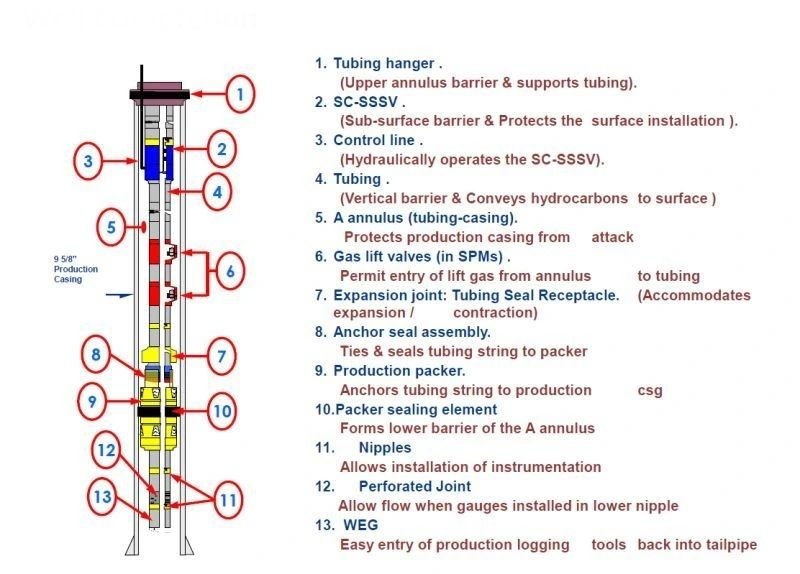
Well completion is the engineering backbone that ensures safe and efficient hydrocarbon flow from reservoir to surface. Here is a snapshot of the key components and their functions based on the completion schematic:
Safety & Barrier System
• Tubing Hanger (1) & SC-SSSV (2): Supports the tubing string and acts as the primary subsurface safety barrier to protect surface installations.
• Control Line (3): Hydraulically operates the SC-SSSV from the surface.
Flowpath & Artificial Lift
• Tubing (4) & Gas Lift Valves (6): Conveys hydrocarbons to the surface, utilizing lift valves in SPMs to permit gas entry from the annulus and boost production.
• A Annulus (5): The tubing-casing space; keeping it isolated protects the production casing from corrosion and stress.
Isolation & Thermal Dynamics
• Expansion Joint (7): Accommodates tubing expansion and contraction caused by temperature and pressure changes.
• Production Packer (9 & 10): Anchors the tubing string and seals the “A” annulus, creating a robust lower barrier to isolate production zones.
Lower Tailpipe & Monitoring
• Nipples & Perforated Joint (11 & 12): Allows gauge/instrumentation installation while ensuring continuous flow.
• WEG (13): The Wireline Entry Guide ensures smooth re-entry for production logging and intervention tools into the tailpipe.