
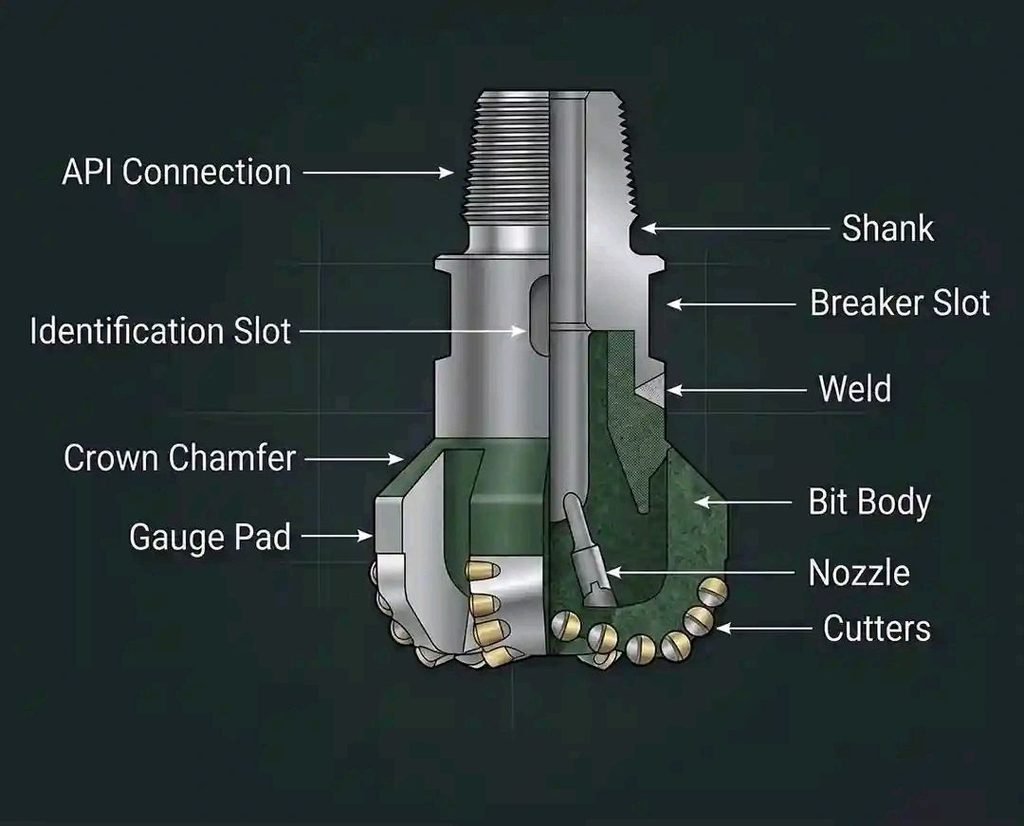
The image shows a cross-sectional view of a fixed cutter drill bit (commonly a PDC bit) used in the oil and gas industry for drilling wells. Here’s a clear explanation of each
labeled component and its function:
Main Components and Their Functions
- API Connection
The threaded top section.
Used to connect the drill bit to the drill string (drill pipe or BHA).
Standardized by the American Petroleum Institute (API).
- Shank
The upper structural portion below the connection.
Transfers weight and torque from the drill string to the bit.
Provides mechanical strength.
- Breaker Slot
A machined slot that allows easier removal of the bit if stuck.
Helps apply tools (like bit breakers) to unscrew the bit.
- Identification Slot
A marking or slot used for identification (serial number, type, size).
Helps track the bit for operational and maintenance purposes.
- Weld
The joint where different sections (like shank and bit body) are fused.
Ensures structural integrity under high stress.
- Bit Body
The main body of the drill bit (often made of steel or matrix material).
Houses internal fluid channels and supports cutters.
Designed to withstand abrasion and high temperatures.
- Nozzle
Openings that direct drilling fluid (mud) toward the bottom of the hole.
Functions:
Clean cuttings from the bit face
Cool the cutters
Improve drilling efficiency
- Cutters (PDC Cutters)
The cutting elements made of polycrystalline diamond compact (PDC).
Shear the rock rather than crushing it (unlike roller cone bits).
Provide fast drilling in soft to hard formations.
- Gauge Pad
Maintains the diameter (gauge) of the borehole.
Stabilizes the bit and reduces vibration.
Prevents hole enlargement.
- Crown Chamfer
The transition area between the bit face and gauge.
Helps reduce stress concentration and improves durability.
How It Works in Drilling
The drill string rotates the bit.
Weight on bit (WOB) pushes it into the formation.
PDC cutters shear the rock.
Drilling fluid exits through nozzles:
Removes cuttings
Cools and lubricates
Gauge pads maintain hole size and stability.
Why This Bit Is Important
Used in directional and horizontal drilling
Provides faster penetration rates (ROP)
Longer lifespan compared to roller cone bits in many formations.