
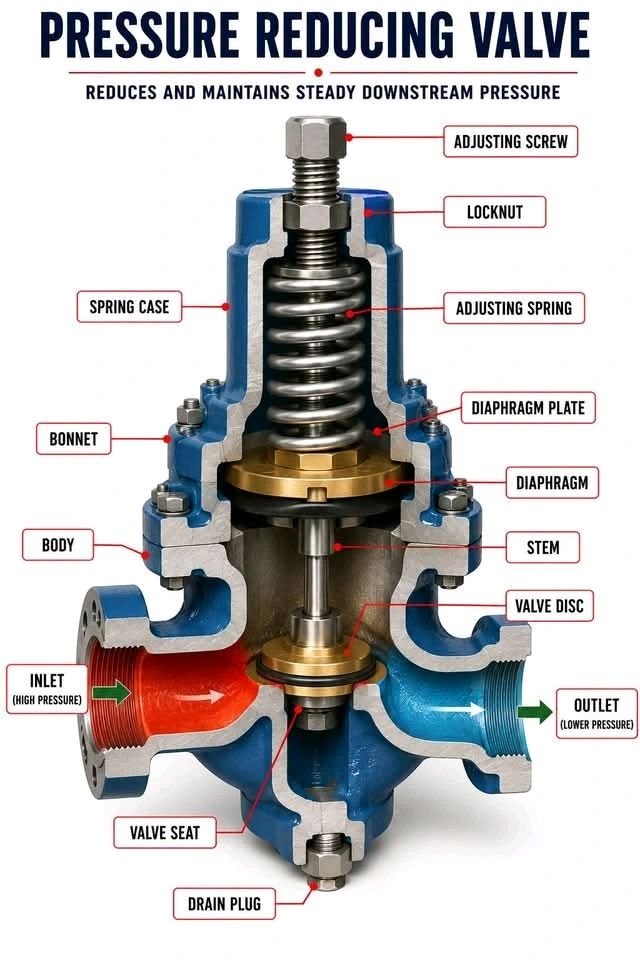
The pressure reducing valve (PRV) is an important control valve used onboard ships to reduce high inlet pressure and maintain a constant lower outlet pressure for downstream systems. It ensures safe and stable operation of pipelines, machinery, steam systems, air systems, and auxiliary equipment.
High-pressure fluid enters through the inlet side and passes across the valve seat and valve disc. The diaphragm and adjusting spring continuously sense outlet pressure changes and automatically regulate the valve opening. When downstream pressure rises above the set value, the valve partially closes to reduce flow. If pressure drops, the valve opens wider to maintain the required outlet pressure.
The adjusting screw is used to set the desired downstream pressure, while the locknut secures the adjustment setting. The stem transfers movement from the diaphragm assembly to the valve disc, controlling the flow through the valve body. The spring case protects the internal spring mechanism and allows smooth pressure regulation.
Pressure reducing valves are commonly used in steam lines, fuel systems, compressed air systems, fresh water supply systems, and heating systems onboard ships. Proper pressure control prevents damage to pipelines, machinery, seals, and downstream equipment caused by excessive pressure.
Regular maintenance includes checking for leakage, diaphragm condition, spring tension, valve seat wear, corrosion, and proper calibration. A properly functioning PRV improves system safety, operational efficiency, and equipment reliability throughout marine engineering systems onboard vessels.