
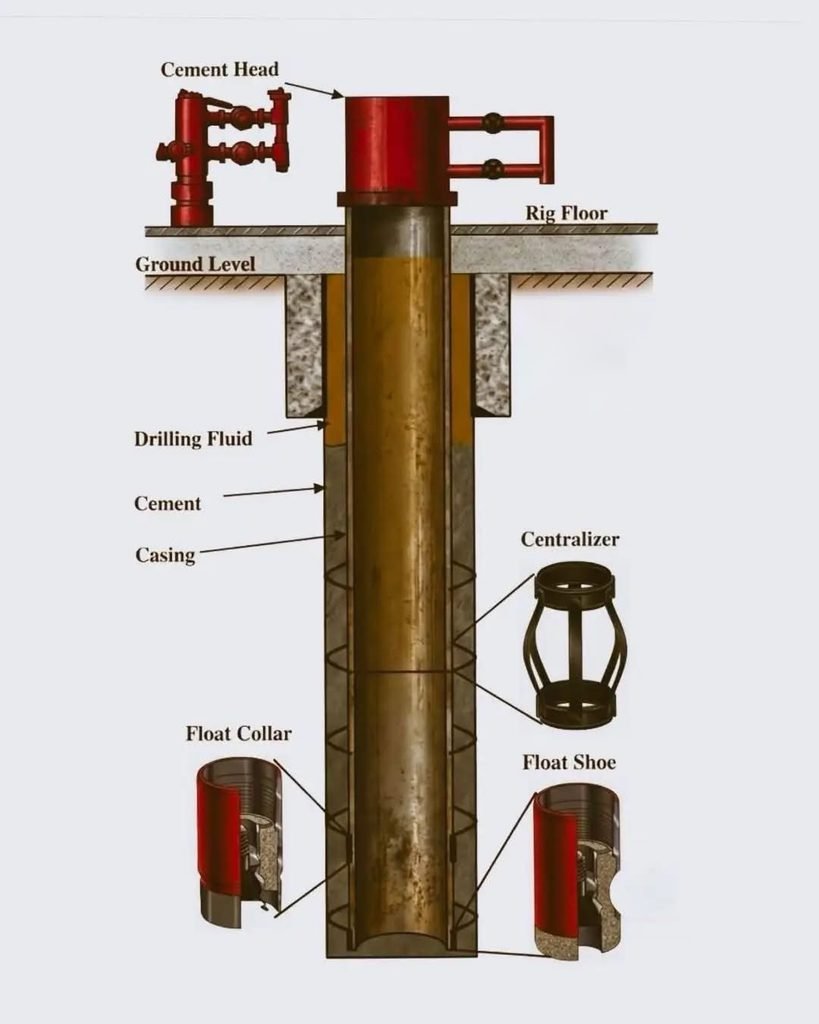
The structural integrity of the well is the cornerstone of ensuring the efficiency and long-term sustainability of production processes. The naming processes represent a critical engineering phase that aims to create an integrated cement casing that ensures layered insulation, prevents fluid leakage, and maintains the integrity of the well. This process relies on an integrated system of equipment that is precisely designed to achieve optimal cement distribution under complex operating conditions.
The main components and their functional role are as follows:
Cement Head:
It is the starting point for the cement mix pumping process, as it is characterized by its design that is able to withstand high pressures, while ensuring the efficient and precise control of the cement liquid, which contributes to achieving a regular and disturbance-free pumping process.
Casing String:
It is the basic structural element that requires protection, as the homogeneous distribution of cement around it ensures effective isolation between the different geological layers, as well as enhancing the mechanical stability of the well.
Float Equipment – Collar & Shoe:
It plays a vital role in controlling the direction of flow through the one-way valve property, which prevents cement from returning to the casing shaft, and contributes to maintaining hydraulic balance during and after the pumping process.
Centralizers:
They are used to ensure that the casing column is centered inside the well, which improves the stand-off value, and leads to a homogeneous distribution of the cement casing, thus forming a cement layer with high mechanical properties and superior insulation ability.