
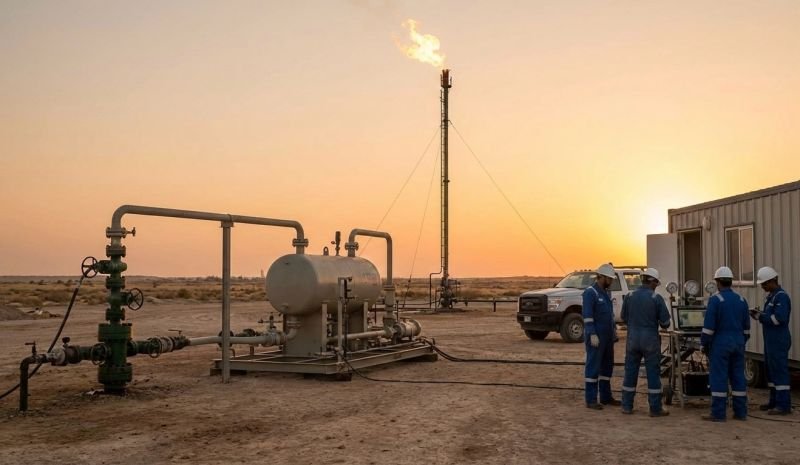
Wireline logs and core samples are incredibly valuable, but they only give us a static picture of the rock right next to the wellbore. If we want to know how the entire reservoir will actually perform, we have to open the valve.
Definition:
Well Testing is the process of temporarily flowing a well under highly controlled conditions to gather dynamic data. By carefully measuring flow rates and pressure changes over time, engineers can mathematically “see” deep into the reservoir.
Why we test:
- Effective Permeability (k): Logs estimate permeability, but a well test proves exactly how well the fluid flows across a massive area.
- Skin Factor (S): This measures near-wellbore damage. A positive Skin means our drilling mud clogged the pores (damage). A negative Skin means our fracking or acid job worked (stimulation).
- Reservoir Limits: By tracking how pressure waves travel, we can detect hidden faults, pinch-outs, or the actual size of the underground “tank.”
- Fluid Sampling: Capturing uncontaminated oil, gas, and water for PVT laboratory analysis.
Types of Tests:
Depending on the stage of the well’s life, we run different tests. In the upcoming posts, we will dive deep into each of these:
- Drill Stem Test (DST): The “first look.” Conducted while the drilling rig is still on location to quickly evaluate a new zone.
- Drawdown Test: Flowing the well at a constant rate and analyzing how fast the pressure drops.
- Buildup Test: Shutting the well in after it has been flowing to analyze how the pressure recovers.
- Production Testing: Routing the fluids through a surface separator to accurately measure the Gas-Oil Ratio (GOR) and Water Cut.