
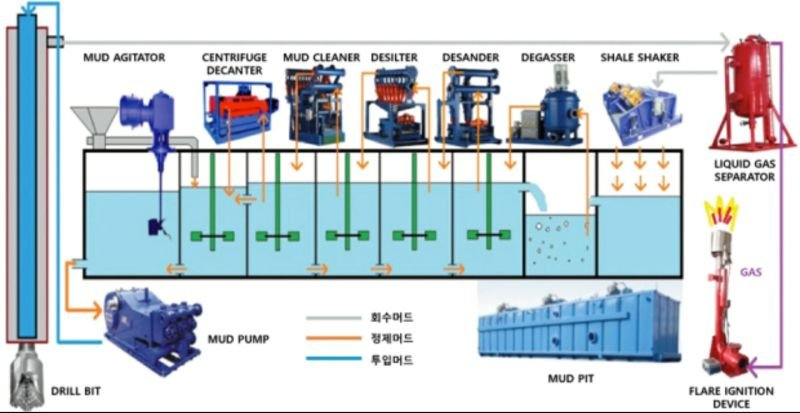
Yesterday we discussed how solids can accumulate in the mud system during drilling.
But how are these solids actually removed?
The answer lies in solids control equipment.
Solids control is a critical part of drilling operations, ensuring that unwanted solids are removed while maintaining the desired properties of the drilling fluid.
On a drilling rig, several pieces of equipment are used in sequence to achieve this:
- Shale Shakers – the first line of defense, used to remove large cuttings from the returning mud
- Desanders – remove medium-sized particles using hydrocyclone technology
- Desilters – remove finer solids that pass through earlier stages
- Centrifuges – separate ultra-fine solids from the mud using high-speed rotation
Each stage targets different particle sizes, helping to maintain optimal mud properties and system efficiency.
Effective solids control helps:
- Maintain proper viscosity
- Improve rate of penetration (ROP)
- Reduce wear on equipment
- Lower overall drilling costs
Without proper solids control, drilling fluids can quickly become overloaded with unwanted solids, leading to poor performance and operational challenges.
Professional insight:
Mud engineers and drilling personnel — which solids control equipment do you find most critical during drilling operations?
Food for Thought:
Why do you think solids control equipment is arranged in stages rather than using a single system?
30 Days of Mud Engineering-Day 1-What Is Drilling
30 Days of Mud Engineering-Day 2-What Is Drilling Fluid
30 Days of Mud Engineering-Day 3-How Does Drilling Fluid Control Formation Pressure
30 Days of Mud Engineering-Day 4-How Do Engineers Determine The Right Mud Weight for a Formation
30 Days of Mud Engineering-Day 6-Mud Weight
30 Days of Mud Engineering-Day 7-Why Must Drilling Mud Flow Properly
30 Days of Mud Engineering-Day 8-What Determines How Drilling Mud Actually Flows Inside The Wellbore
30 Days of Mud Engineering-Day 9-Plastic Viscosity (PV) and Yield Point (YP)
30 Days of Mud Engineering-Day 10-Fluid Loss or Filtration
30 Days of Mud Engineering-Day 11-Retort Test
30 Days of Mud Engineering-Day 12-How Stable Is The Emulsion
30 Days of Mud Engineering-Day 13-Water-Based Mud (WBM) and Oil-Based Mud (OBM)
30 Days of Mud Engineering-Day 14-Shale
30 Days of Mud Engineering-Day 15-Shale Inhibition
30 Days of Mud Engineering-Day 16-KCl–Polymer Mud
30 Days of Mud Engineering-Day 17-What Happens to All the Solids Generated During Drilling
30 Days of Mud Engineering-Day 18-How Do Mud Engineers Remove Unwanted Solids From Drilling Fluid
30 Days of Mud Engineering-Day 19-How Do Mud Engineers Maintain The Right Mud Weight During Drilling
30 Days of Mud Engineering-Day 20-Hole Cleaning
30 Days of Mud Engineering-Day 21-Stuck Pipe (Very High Engagement Topic)
30 Days of Mud Engineering-Day 22-Lost Circulation
30 Days of Mud Engineering-Day 23-Lost Circulation Materials (LCM)
30 Days of Mud Engineering-Day 24-Barite Sag
30 Days of Mud Engineering-Day 25-Gas Contamination
30 Days of Mud Engineering-Day 26-Downhole Temperature Impact On the Drilling Fluids
30 Days of Mud Engineering-Day 27-What Is The Role Of A Mud Engineer
30 Days of Mud Engineering-Day 28-How Dynamic The Role of Mud Engineer
30 Days of Mud Engineering-Day 29-What Skills Are Essential For A Mud Engineer